
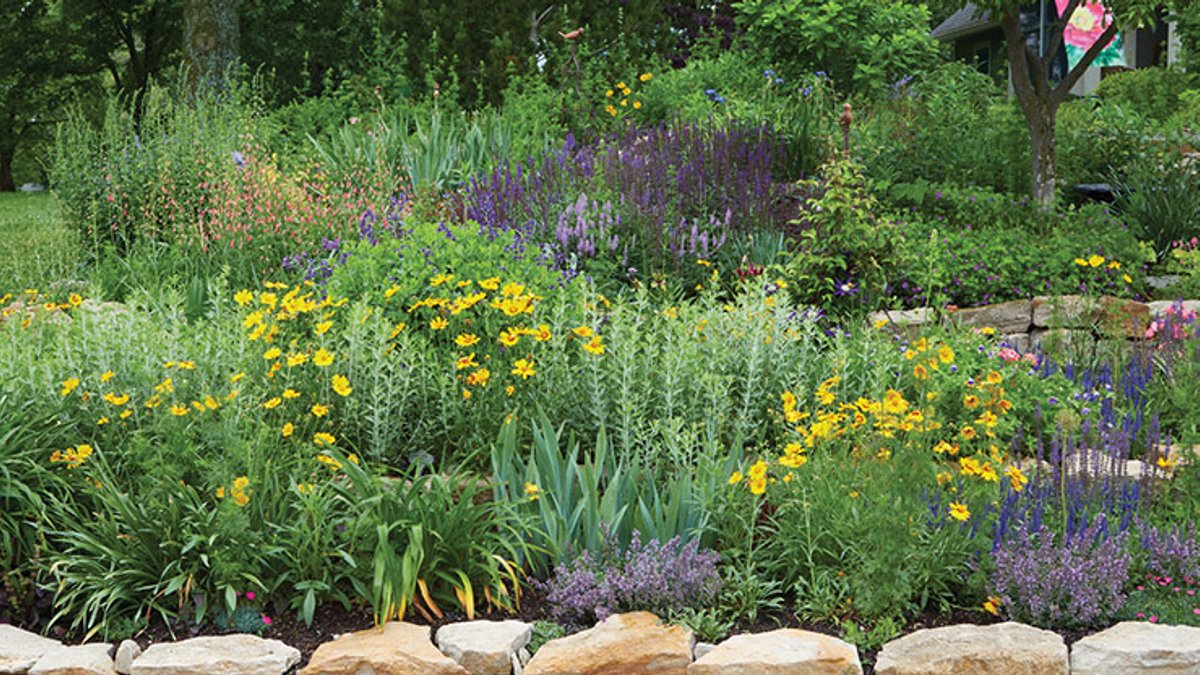
A Kansas gardener, Joyce Householder, has created a beautiful terraced perennial border that combines colorful perennials with contrasting textures and forms. The garden helps manage runoff and erosion, and its design takes into account each plant’s growth habit, branching pattern, and leaf shape.
Creating a Texture-Packed Perennial Border
Large, solid leaves command attention and visually make a space seem smaller, while fine, delicate foliage seems to recede, creating a more open, spacious feeling. Grassy or swordlike blades add striking vertical lines, and when combined, this patchwork of varied plant shapes gives a garden depth as light and shadow play across the greenery.
A garden with great texture is eye-catching, even when no flowers are in bloom. The plants and design details behind this sunny perennial border include a mix of perennials such as salvia, speedwell, and bearded iris, which provide a constant contrast of textures and forms.
Related: 5 Garden Mistakes Attracting Pests
Terracing and Plant Selection
Terracing on this slope helps to slow rainwater runoff and control erosion in Joyce’s garden. The added benefit is a better view of the gorgeous assortment of perennials that grow here in full sun. Although flowers come and go through spring and summer, the constant is the contrast between the strappy bearded iris foliage, velvety Russian sage leaves, and solid mounds of false indigo.
To encourage a light rebloom, it’s recommended to cut back salvia, spike speedwell, bearded penstemon, and catmint after the first flush of flowers fade. Additionally, snipping faded iris blossoms helps keep the plant tidy, while allowing spent false indigo flowers to form black seed pods that look intriguing through fall and winter.
Most of these perennials die back to the ground in winter, so it’s best to cut off dead foliage in late fall after a frost or in early spring as new growth begins. Russian sage stems can stay standing all winter to provide structure, and it’s semi-evergreen in warmer hardiness zones.
Related: Luxury apartment in Muscat showcases bold design
For gardeners looking to create a similar perennial border, they must consider the specific growing conditions and plant selections. By choosing perennials that thrive in full sun and well-draining soil, they can create a garden that requires minimal maintenance.
Perennial Border Plant List
The plant list for this sunny perennial border includes:
- Salvia (Salvia nemorosa ‘Caradonna’): a perennial with deep blue-violet flower spikes from early summer through fall
- Speedwell (Veronica ‘Lavender Lightsaber’): a perennial with lavender flower spikes in early to midsummer
- False indigo (Baptisia ‘Sparkling Sapphires’): a perennial with violet-blue flowers in late spring to early summer
- Bearded penstemon (Penstemon barbatus ‘Jingle Bells’): a perennial with red-orange tubular flowers on long stems from late spring to early summer
- Russian sage (Perovskia atriplicifolia): a perennial with tiny lavender-blue flowers line tall stems of silver, fernlike foliage from mid- to late summer
Joyce Householder’s garden is a perfect example of a well-designed perennial border.


