
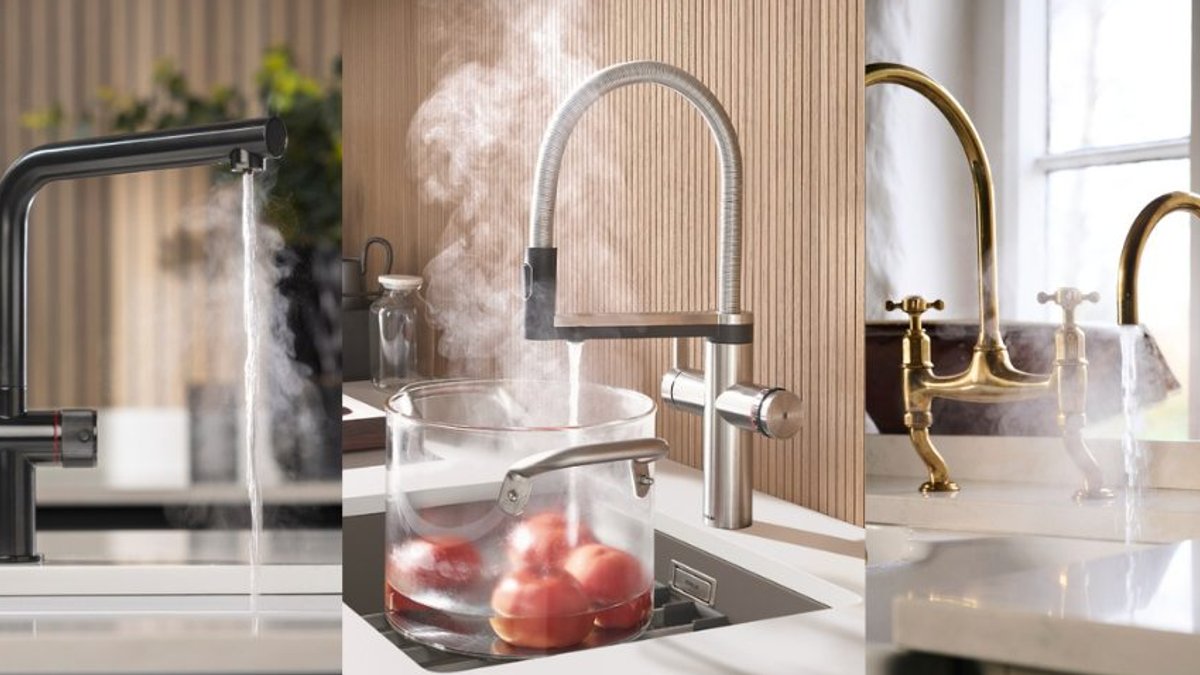
The boiling-water tap has evolved from a luxury kitchen gadget to a standard feature in contemporary homes, offering faster access, greater convenience, and potential energy savings. Pricing varies, with models ranging from £740 (such as Koge’s 4-in-1 tap) to over £3,000, depending on features and brand. Homeowners frequently cite the elimination of kettle-related delays as a primary benefit.
A single tap can replace multiple appliances, from boiling water for tea to cooking pasta, while reducing countertop clutter. “One elegant tap can replace the kettle entirely, and the kettle is often the single biggest piece of clutter on a worktop,” says Brani Hadzhi, creative director and co-founder of Multiliving Scavolini. “In smaller kitchens particularly, that’s transformative.” And even in smaller kitchens, the good news is that there are many new compact designs available.
This trend aligns with broader kitchen design shifts toward open layouts, where minimizing surface clutter holds equal importance to functionality. “This shift is closely linked to the way kitchens have evolved into open, more visible environments, where reducing surface clutter has become just as important as improving performance.
So, removing a kettle and a separate filtration system in favour of a single, well-designed tap has a noticeable impact, not only in practical terms but in how cohesive the space feels as part of a wider living area,” says Michael Sammon, design director at Wodar. Modern finishes ensure the tap complements both contemporary and traditional aesthetics. Installation challenges have diminished over time.
While pre-planning during renovations simplifies the process—accounting for under-sink tank space and electrical connections—retrofitting remains feasible in most kitchens. “Boiling-water taps can easily be retrofitted into an existing kitchen, provided there is access to power and sufficient room beneath the sink,” says Amie Gee, marketing manager at Franke. “Most systems include a compact tank that sits neatly within the sink base cabinet.” Typically, you’ll need space similar to a small kitchen bin or cleaning caddy, so it’s still important to plan storage accordingly. Cost remains the most significant barrier to adoption. Entry-level models begin at £740, while high-end versions, particularly those with filtration or sparkling water capabilities, can exceed £3,000. Energy efficiency stands out as a major advantage.
Related Post: Warm terracotta kitchen features fluted wood island
On-demand boiling eliminates the waste of heating entire kettles or pots. “Hot-water taps are a game changer if you’re looking to save energy and cut down on electricity bills,” says Luke Shipway, head of product at Caple. Households that frequently use hot water, whether for cooking, cleaning, or beverages, may recover the upfront cost within a few years. Safety considerations are especially relevant in homes with children or elderly residents.
Modern taps include features like locking mechanisms or adjustable temperature controls to prevent scalding. “While the term boiling-water tap is widely used, it is technically inaccurate, as most systems deliver water just below boiling point at around 98°C,” explains Michael. “In practical terms, this has no real impact on how the tap is used, whether for drinks or food preparation, and reflects the safety measures built into the design.”
Not every kitchen suits these taps. Low water pressure can result in weak flow, while high pressure may necessitate a pressure-reducing valve. “Pipework design also plays a big role. Use 22mm pipework on the main feed wherever possible, avoid long runs in 15mm piping, and keep pipe routes short and direct.
Having excessive elbows and tees in the pipework will only restrict flow and reduce efficiency,” says Richard Bambridge, training manager at Salamander Pumps. Smaller kitchens may face space limitations, though compact tank designs help address this issue. Regular maintenance is often underestimated. Hard-water regions risk limescale buildup, and filters require replacement every 4, 6 months. “These taps demand ongoing care, much like a boiler,” Gee advises. Neglecting maintenance can lead to decreased efficiency or system failure. For users prioritizing convenience and modern design, the trade-offs may prove worthwhile.
A boiling-water tap removes daily inconveniences, no waiting, no clutter, and can enhance water quality through built-in filtration. However, it is not a universal solution. Space constraints, budget limitations, and household needs must align before making the investment. The decision ultimately depends on usage patterns. Heavy tea drinkers, pasta enthusiasts, or families relying on hot water for cleaning may experience rapid payback. Others might find the savings and convenience insufficient to offset the cost. As with any kitchen upgrade, thorough research and professional consultation are essential before proceeding.


