
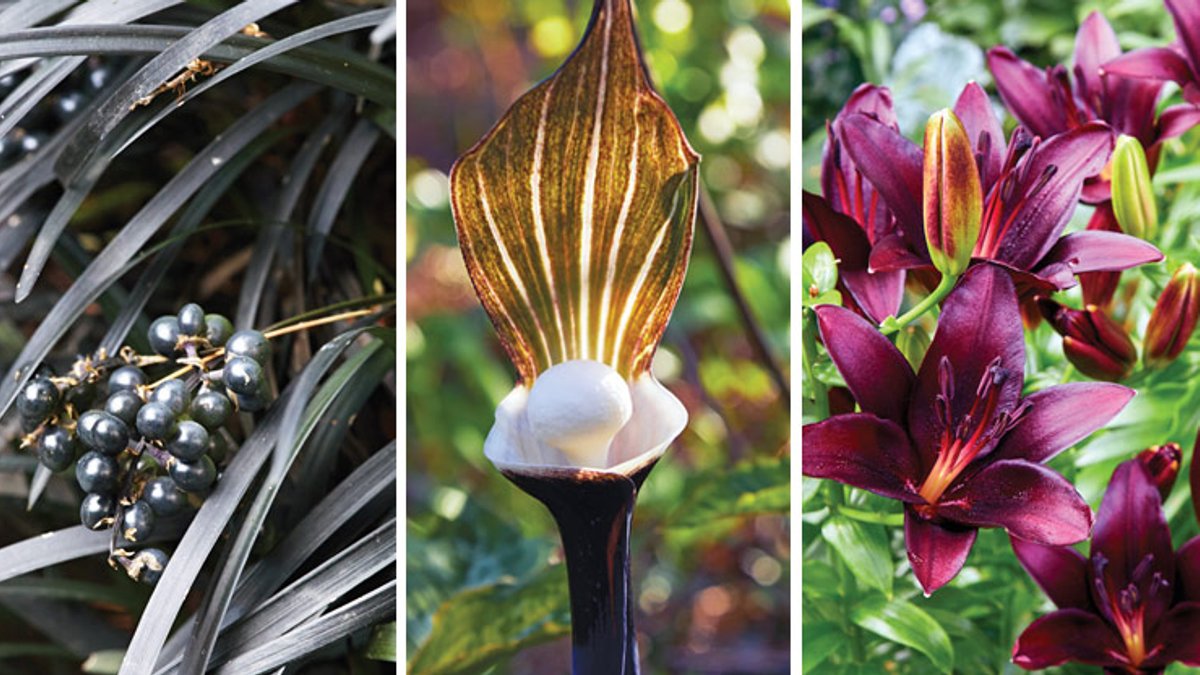
A garden doesn’t need bright colors to stand out. Some of the most effective settings use deep, moody hues—what gardeners call a midnight or gothic-style garden. While no flower is truly black, many plants appear nearly so, with petals that shift between burgundy, purple, and inky darkness depending on the light.
The illusion of black in the garden
These plants don’t produce true black pigment. They rely on dense concentrations of anthocyanins, the same compounds that give red cabbage and eggplants their color. In low light, the effect becomes more pronounced; in full sun, some varieties reveal undertones of deep red or violet.
Pairing them with the right companions strengthens the effect. Silver foliage, like that of ‘Jack Frost’ brunnera or lamb’s ear, creates contrast, while lush greens from ferns or hostas prevent the darker plants from blending into the background. White and pale flowers act as highlights, drawing the eye and keeping the design from feeling too heavy.
Designing for drama
The appeal of a gothic garden extends beyond the plants. Lighting, reflections, and even the time of day influence the atmosphere. Soft solar lights along a path or beside dark foliage can extend the mood into the evening. Gazing balls or mirrors catch ambient light, deepening the sense of mystery. The aim isn’t to create something eerie but to craft a space that feels deliberate—elegant, atmospheric, and far from ordinary.
Related: Vibrant Perennials Brighten Up Front Yards
The following selection includes plants that reliably produce the darkest tones. Some are perennials, others annuals; some thrive in shade, others in sun. All share one trait: they make a bold statement.
Plants to anchor a gothic garden
Japanese cobra lily (Arisaema sikokianum) looks like it belongs in a fairy tale. In early spring, a hooded bloom rises above silver-splashed leaves, its spathe striped in purple, green, and white. By late summer, the flowers fade, leaving behind a cone of bright red berries that persist long after the foliage dies back. It prefers moist, humus-rich soil and dappled shade—too much sun can scorch its delicate leaves. Grown from seed, it can take three to five years to bloom. Japanese cobra lily is deer-resistant.
‘Green Wizard’ coneflower (Rudbeckia occidentalis) skips the usual yellow petals in favor of a nearly black central cone framed by green sepals. The effect is striking, almost architectural.
Black bat flower (Tacca chantrieri) is the most unusual of the group. Its broad, winglike bracts resemble a bat in flight, with whisker-like filaments extending from the center. Native to Southeast Asia, it thrives in warm, humid conditions and is often grown as a houseplant or annual in cooler climates. In summer, it can live outdoors in shade but must be brought inside before temperatures drop.
‘Black Barlow’ columbine (Aquilegia vulgaris var. stellata) provides a delicate option. Its fully double, pom-pom-like blooms nod on slender stems, their deep plum color standing out against lacy green foliage. Hummingbirds favor it, and it self-seeds easily, naturalizing over time.
Related: Carla Coulson discusses new floral photography series
‘Black Sprite’ perennial bachelor’s button (Centaurea montana) is a moody twist on a cottage garden classic, with feathery, thistlelike blooms in near-black burgundy.
These plants add more than color. They bring texture, movement, and an interplay with light. A garden designed around them doesn’t reject brightness but offers a different kind of contrast. Darkness in nature is rarely uniform—it shifts and reveals itself in unexpected ways.
Success depends on giving these plants space. Too many dark tones in one area can feel overwhelming; balancing them with lighter elements keeps the design cohesive. While often associated with gothic aesthetics, they fit just as well in modern, minimalist, or traditional gardens. The impact lies in the details, not the theme.
For more ideas on creating striking garden beds, building better garden beds can help refine your approach.


